


The Man Without Qualities
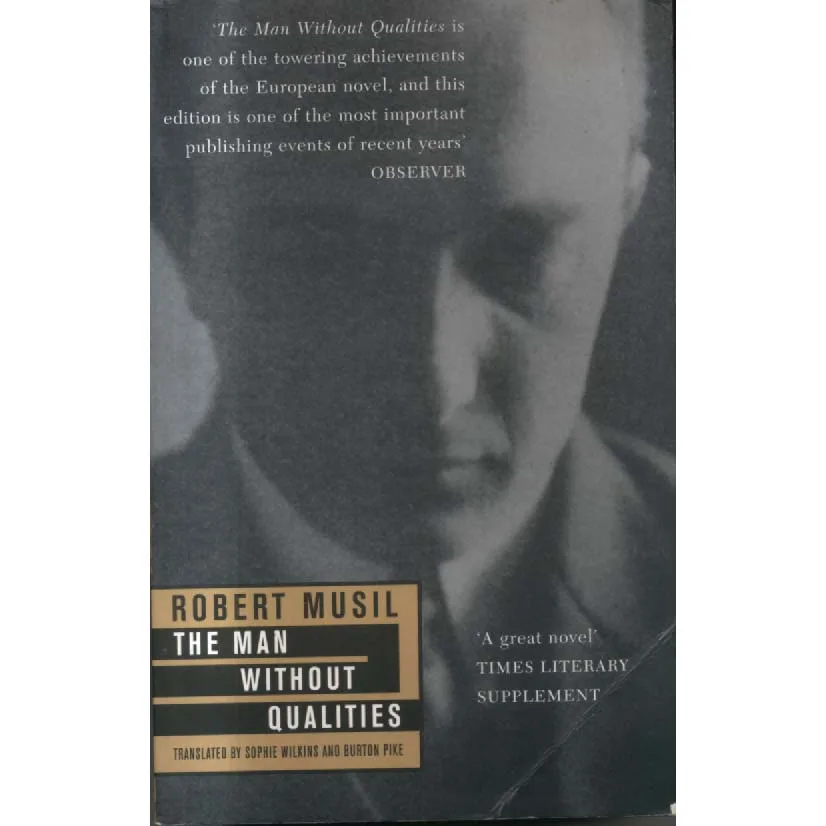
Publisher: Picador
Format: Paperback
ISBN: 9780330349420
The Man Without Qualities (1995) by Robert Musil
Picador | ISBN: 9780330349420 | Condition: Good
There are people who know exactly what they want from life, people who have a vague idea what they might like to do next Thursday, and then there is Ulrich, the central character of Robert Musil’s monumental The Man Without Qualities, a gentleman whose principal achievement appears to be possessing sufficient intelligence to recognise the absurdity of almost everything while remaining magnificently incapable of deciding what to do about any of it. In this extraordinary novel, Musil sets out to examine the intellectual, political, sexual, philosophical and social contradictions of European civilisation, producing a work of such enormous ambition that he spent much of his life writing it and still failed to finish the thing. As literary undertakings go, this is approximately equivalent to setting out to redecorate the sitting room and accidentally attempting to reconstruct the entire Austro-Hungarian Empire.
First published in German beginning in 1930, The Man Without Qualities is one of the great modernist novels of the twentieth century, standing alongside the works of James Joyce, Marcel Proust and other literary giants who apparently concluded that the conventional novel, with its beginning, middle, end and reasonably identifiable plot, was an unnecessarily restrictive arrangement. Musil’s masterpiece is vast, intellectually demanding, frequently hilarious and gloriously unwilling to hurry towards any particular destination, which makes it an unusually appropriate literary monument to the civilisation it describes.
The story unfolds in Vienna in 1913, as the Austro-Hungarian Empire approaches the catastrophe of the First World War with the serene confidence of an elderly aristocrat stepping onto an escalator travelling in the wrong direction. The empire is an elaborate political construction of competing nationalities, ancient institutions, social hierarchies and bureaucratic traditions, all held together by habit, ceremony and the increasingly questionable assumption that the entire arrangement possesses a future.
At the centre of this magnificent confusion stands Ulrich, a thirty-two-year-old mathematician, intellectual and general-purpose observer of human absurdity. He possesses intelligence, education, charm and considerable potential, but lacks the firm convictions and clearly defined ambitions that society generally expects of a respectable adult. He has tried various occupations without discovering anything sufficiently meaningful to justify devoting his existence to it, and has consequently decided to take a year’s holiday from life while he considers his options.
This is, naturally, a dangerous decision for an intelligent man. The moment one begins seriously examining the foundations of human existence, ordinary activities such as earning money, attending meetings and pretending to find other people’s opinions interesting can become extraordinarily difficult to justify.
Ulrich inhabits a world populated by politicians, aristocrats, military officers, intellectuals, romantics, social reformers and assorted individuals who possess firm opinions about practically everything while displaying remarkably little understanding of anything. Musil observes these characters with a devastating combination of psychological insight and philosophical humour, exposing the vanity, self-deception and extraordinary intellectual gymnastics through which people persuade themselves that their particular obsessions represent matters of enormous historical importance.
Much of the novel revolves around the wonderfully ridiculous Parallel Campaign, an elaborate patriotic enterprise intended to celebrate the seventieth anniversary of Emperor Franz Joseph’s reign in 1918. Unfortunately, history has already arranged that the empire will not survive long enough to enjoy the festivities, a small administrative inconvenience of which the characters remain blissfully unaware.
The organisers devote themselves to committees, discussions, proposals and ambitious declarations about the spiritual greatness of Austria, while remaining largely incapable of agreeing upon what exactly they are supposed to be celebrating. Their efforts produce an endless procession of meetings, intellectual arguments and grandiose schemes, all conducted with the solemn seriousness that bureaucracies generally reserve for activities that achieve absolutely nothing.
It is one of literature’s most magnificent depictions of official pointlessness. Important people gather to discuss important matters, establish important committees and produce important statements, while the actual world proceeds towards disaster with complete indifference to their contributions. Readers familiar with modern politics, corporate management or local authority planning departments may experience an uncomfortable sensation of recognition.
Musil’s satire is particularly effective because his characters are rarely simple fools. Many are educated, accomplished and perfectly capable of sophisticated reasoning. Their difficulties arise from the remarkable human ability to employ intelligence in the service of vanity, prejudice and self-interest, constructing elaborate philosophical justifications for desires that might otherwise be explained by jealousy, ambition, sexual frustration or an overwhelming wish to be invited to the right dinner parties.
There is Diotima, the society hostess whose aspirations towards spiritual and cultural greatness are matched by her enthusiasm for fashionable ideas and distinguished acquaintances. Her salon becomes a gathering place for intellectuals and influential figures, providing an environment in which enormous abstract questions can be debated at considerable length without anybody being required to produce a useful conclusion.
Then there is Arnheim, the immensely wealthy and intellectually ambitious industrialist who represents the fascinating union of money, power and cultural pretension. He possesses the resources to influence events and the vocabulary to make his ambitions sound considerably nobler than the accumulation of commercial advantage. His presence offers Musil ample opportunity to examine the relationship between wealth and intellectual prestige, a subject that has hardly become less relevant since the collapse of the Habsburg monarchy.
The military, too, contributes its own distinctive understanding of civilisation. General Stumm von Bordwehr approaches the intellectual world with the practical instincts of a professional soldier, attempting to impose order upon ideas that stubbornly refuse to behave like properly disciplined infantry formations. His encounters with philosophy and literature are among the novel’s more entertaining episodes, particularly as he discovers that intellectuals have developed an extraordinary capacity for disagreeing about subjects whose practical significance remains obscure.
Meanwhile, the novel examines the darker currents flowing beneath respectable society. Criminality, sexuality, moral uncertainty and psychological disturbance form part of Musil’s exploration of a civilisation whose public commitment to order and decency conceals profound contradictions. The disturbing figure of Moosbrugger, a murderer whose case attracts intense intellectual fascination, becomes a vehicle for examining questions of responsibility, madness, justice and society’s uneasy relationship with violence.
Musil’s treatment of these subjects is anything but straightforward. He is interested not simply in what people do, but in the elaborate systems of thought through which they interpret their behaviour. Morality, politics, science, religion and personal identity become competing ways of understanding a world that persistently refuses to fit into any convenient explanation.
This is where The Man Without Qualities becomes considerably more than a satire of the dying Austro-Hungarian Empire. It is a vast investigation into modern consciousness, asking what happens when traditional values lose their authority, scientific reasoning challenges inherited beliefs and intelligent individuals discover that almost any conviction can be examined until it begins to fall apart.
Ulrich’s condition is therefore not simply indecision or laziness. He embodies the modern individual’s difficulty in committing to a particular identity when so many alternatives appear possible. He can imagine different lives, different moral systems and different interpretations of reality, but this very openness prevents him from embracing any one of them with complete conviction.
The man without qualities is, paradoxically, a man with so many possible qualities that none has become definitive.
It is a predicament that may strike an uncomfortable chord with readers who have spent years considering alternative careers, postponed important decisions indefinitely or developed the habit of examining every possible consequence until the original opportunity has quietly disappeared. Musil might not provide much assistance in resolving such difficulties, but he certainly offers the consolation that they can be transformed into several thousand pages of distinguished European literature.
The novel’s extraordinary length and complexity are integral to its character. Musil does not simply describe a society; he takes it apart, examines its philosophical machinery, questions the assumptions upon which it operates and then discovers another seventeen subjects that require equally detailed investigation. Conversations become essays, incidents develop into elaborate reflections and seemingly minor observations open onto vast intellectual landscapes.
Readers seeking a conventional thriller in which something dramatic happens every twelve pages may find the experience somewhat alarming. There are no convenient cliffhangers, heroic car chases or reassuring promises that all mysteries will be resolved before the final chapter. Instead, there is the far more unsettling spectacle of an immensely intelligent author examining the whole of modern civilisation and repeatedly discovering that it makes very little sense.
Yet the book is also frequently very funny. Musil possesses a wonderfully dry and precise sense of humour, finding comedy in the gap between human aspirations and actual behaviour. His characters may believe themselves to be engaged in matters of transcendent significance, but the author has an exceptionally sharp eye for the vanity, pomposity and intellectual absurdity underlying their efforts.
The satire can seem astonishingly contemporary. The obsession with fashionable ideas, the substitution of rhetoric for achievement, the influence of wealthy individuals upon public affairs and the endless creation of committees dedicated to producing impressive statements rather than meaningful results are hardly peculiar to Vienna in 1913.
Indeed, one occasionally suspects that if Musil were resurrected and introduced to modern politics, international conferences and the corporate consultancy industry, he would conclude that humanity had made surprisingly little progress and that his unfinished novel required several additional volumes.
The historical setting gives the work a particularly powerful irony. The reader knows that the First World War is approaching, that the Austro-Hungarian Empire will collapse and that the elaborate society Musil depicts is living on borrowed time. The characters, however, continue their intrigues, debates and romantic complications without recognising the approaching catastrophe.
This contrast between their immediate preoccupations and the historical disaster awaiting them lends the novel a peculiar mixture of comedy and tragedy. Grand discussions about culture and national destiny unfold against the background of a civilisation whose foundations are already beginning to crack, although those responsible for maintaining them are mostly occupied with the seating arrangements.
Musil himself knew the world he described intimately. Born in 1880 in the Austro-Hungarian Empire, he was trained in engineering, studied philosophy and psychology, served during the First World War and developed an intellectual outlook combining scientific precision with profound scepticism about human certainties. His background helped give the novel its extraordinary range, allowing him to approach literature with the analytical instincts of a scientist and science with the imaginative curiosity of a novelist.
Unfortunately, producing a literary work intended to encompass almost everything presents certain practical difficulties, particularly when the author insists upon examining each subject with exceptional care. Musil continued working on The Man Without Qualities for years, repeatedly revising and expanding his material, but died in 1942 without completing the novel.
The result is one of literature’s greatest unfinished masterpieces, a work whose incompleteness seems almost perversely appropriate. A novel devoted to uncertainty, possibility and the impossibility of reaching definitive conclusions ultimately refuses to provide one itself. Whether this represents artistic perfection or the world’s most elaborate case of failing to meet a deadline is a question readers may enjoy debating.
For those who appreciate the great European modernists, Musil offers an extraordinary intellectual experience. His writing combines psychological observation, social satire, philosophical speculation and historical insight on a scale rarely attempted in fiction. He is capable of being profoundly serious and mischievously absurd within the same passage, often leaving the reader uncertain whether to admire the brilliance of an argument or laugh at the ridiculous circumstances that produced it.
There is also something wonderfully defiant about a book of such ambition. In a world increasingly devoted to speed, efficiency and easily digestible entertainment, The Man Without Qualities demands patience, concentration and a willingness to wander through complicated ideas without expecting an immediate reward. It is not a novel designed to be consumed between television advertisements or skimmed while simultaneously checking messages on a mobile telephone.
It expects the reader to think, which is an increasingly unreasonable demand to make of anyone.
This 1995 Picador edition brings Musil’s monumental work to readers who appreciate serious literature, European intellectual history and the peculiar satisfaction of tackling a book that is liable to remain in the memory long after considerably more straightforward novels have been forgotten. It also has the practical advantage of being an impressive object to leave on a coffee table, where its presence may suggest formidable intellectual accomplishments even if the owner has so far progressed no further than the introduction.
Of course, there is a particular type of person who acquires enormous modernist novels primarily for the pleasure of knowing that they possess them. The books are arranged conspicuously upon the shelves, occasionally discussed at dinner parties and periodically removed for the purpose of reminding oneself that they really ought to be read before the end of the decade.
Musil would undoubtedly have found this behaviour fascinating, and might well have devoted an entire chapter to examining the psychological relationship between literary ambition, social prestige and the mysterious human satisfaction derived from owning books one has not yet opened.
For the determined reader, however, the rewards are substantial. The novel offers an extraordinary portrait of a civilisation approaching collapse, together with an examination of the intellectual habits, moral uncertainties and personal contradictions that remain recognisable more than a century after its fictional setting.
This 1995 Picador edition is offered in Good condition by Crappy Old Books, a bookseller that feels a certain sympathy with enormous, intellectually ambitious undertakings that require considerable effort, produce unpredictable results and may never be entirely finished.
Unlike the Austro-Hungarian Empire, the book has survived into the twenty-first century, and unlike the Parallel Campaign, it has succeeded in producing something of lasting cultural importance. Its condition is Good, which is perhaps more than could reasonably be said for the political and philosophical arrangements of the society it describes.
An excellent addition to any collection of modernist fiction, European literature, philosophical novels or works exploring the intellectual crises of the early twentieth century, The Man Without Qualities will appeal to admirers of Joyce, Proust, Kafka, Thomas Mann and other writers who believed that the novel was capable of doing considerably more than simply telling an entertaining story.
It is also an ideal acquisition for readers who enjoy books about the absurdity of human existence, particularly those who have attended enough committee meetings, witnessed sufficient political nonsense or encountered enough self-important intellectuals to suspect that modern civilisation may be an elaborate practical joke whose original organisers have long since disappeared.
A monumental, dazzlingly intelligent and gloriously ironic portrait of a society on the brink of catastrophe, examining the contradictions of modern life through one of literature’s most fascinatingly indecisive protagonists.
And perhaps the greatest achievement of Robert Musil is that he managed to write an enormous novel about a man who cannot quite decide what sort of person he ought to become, set within an empire that cannot quite decide what sort of country it ought to be, while exploring a civilisation that cannot quite decide what it believes in.
It is difficult to imagine a more appropriate literary monument to the twentieth century.
Crappy Old Books: supplying the great works of European literature to readers who appreciate intellectual ambition, philosophical uncertainty and the occasional suspicion that nobody really knows what they are doing.
And should anyone ask whether you have finished reading The Man Without Qualities, you may confidently explain that Robert Musil never finished writing it, so expecting you to complete your side of the arrangement seems a little unreasonable.
After all, a man without qualities should surely be permitted a reader without deadlines.
Keep browsing: See more Fiction books Other books by Robert Musil
